On memory, realism, and the hidden tensions of the painted world
Born in Göttingen, Germany, in 1958 and raised in Munich, Holger Dempwolff is a German-Swiss figurative painter whose work inhabits the elusive territory between realism, romantic imagination, and psychological ambiguity. Educated in Basel, where he completed his artistic studies in 1984, he lives and works between the Swiss Jura near Biel and southern France. Influenced by Vermeer, Salvador Dalí, and Caspar David Friedrich, Dempwolff constructs meticulously detailed visual worlds in which familiar landscapes and everyday encounters acquire an unsettling, sometimes mystical dimension. His paintings invite the viewer to look beyond their apparent tranquility.
Fine Art Magazine: Growing up in an artistic family, how did your early experiences shape your relationship with painting?
Holger Dempwolff: Art was always part of my surroundings. My father was a film composer, my mother worked in cinema, and my grandfather was a painter. As a child, I accompanied my grandfather on watercolor excursions near Munich. He taught me how to observe water, clouds, and natural light. Those lessons stayed with me. Later, I discovered Dalí, Vermeer, and Caspar David Friedrich. Their different approaches to imagination, precision, and atmosphere continue to interest me.
Fine Art Magazine: Your paintings often present idyllic scenes disturbed by something unexpected. What lies behind this tension?
Holger Dempwolff: I describe my work as quiet, figurative painting. I bring together different associations, experiences, and memories, sometimes creating scenes that appear romantic but contain something disturbing. The viewer may initially encounter beauty and harmony, yet gradually notice that something is wrong. I find this ambiguity fascinating. In my painting Light on Earth, for example, the sky is extraordinarily bright, while the landscape remains dark. The light seems unable to reach the earth. I prefer such contradictions to remain subtle. I do not paint loudly.
Fine Art Magazine: Your painting Istanbul brings together seemingly unrelated places and experiences. How does this imaginative construction develop?
Holger Dempwolff: The painting emerged from several impressions. I had admired the rippling water of Lake Maggiore, read about Istanbul, and seen photographs of mountains taken by friends. I combined these with historical ships and the city’s silhouette. The result is an imaginary landscape that nevertheless appears plausible. A dark mountain introduces an uncertain threat. It could suggest a natural disaster or something entirely different. My images often develop like dreams, where fragments of experience form unexpected relationships.
Fine Art Magazine: Your work demands extraordinary patience. How do you reconcile technical precision with artistic imagination?
Holger Dempwolff: I usually begin with photographic references and sketches, arranging the elements into a coherent composition. Sometimes I use a grid to transfer details onto the canvas. Then I develop the painting through successive layers. My eagle painting, exhibited at the Rothko Museum, required approximately 500 to 600 hours, including preparation. The greatest danger is losing oneself in details. One must continually consider the entire composition, balancing sharpness and softness, light and darkness.
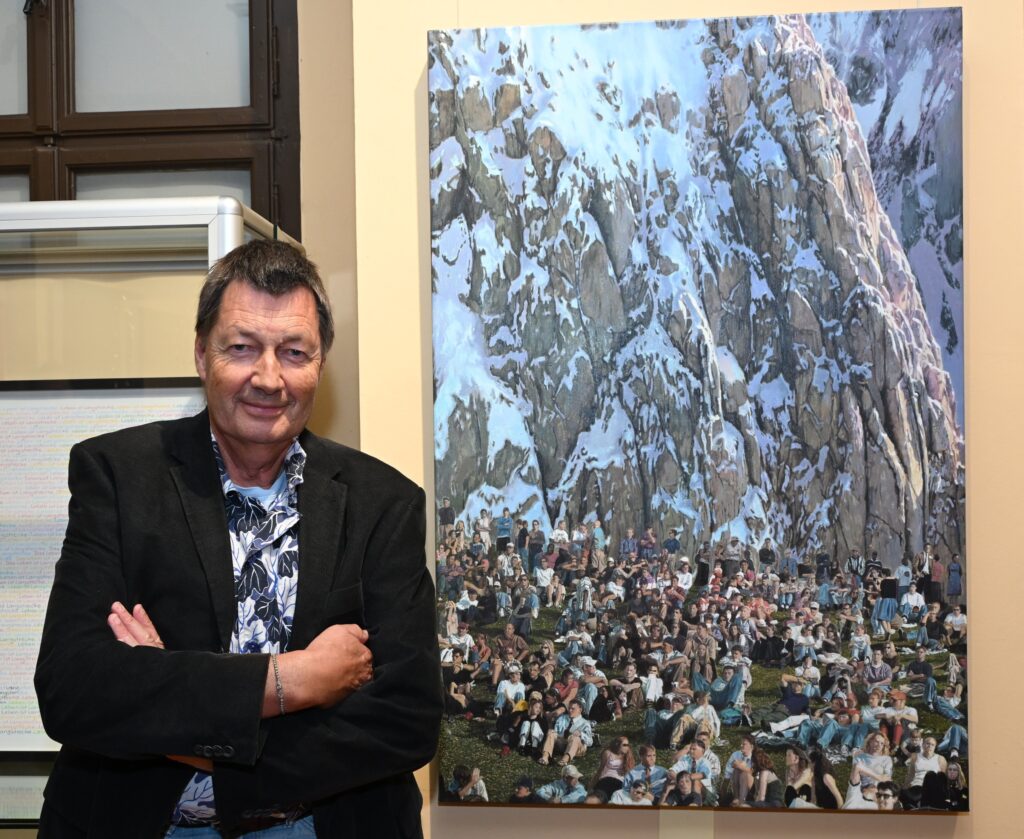
Fine Art Magazine: At the Museen der Schloss- und Residenzstadt Greiz, among other works, you presented Le Concert. What makes this painting particularly significant?
Holger Dempwolff: Le Concert was an enormous exercise in patience. It depicts a society gathered in conversation before a concert, with many small figures, each possessing an individual face. Painting these faces was extremely demanding. But the real subject is not simply the gathering itself. Behind the people, I introduced a massive rock face that does not exist in reality. For me, it suggests how social pleasures and conversations can continue while something threatening remains unnoticed in the background. I do not want to give the image an explicitly contemporary interpretation. I enjoyed creating it immensely although it required enormous patience.
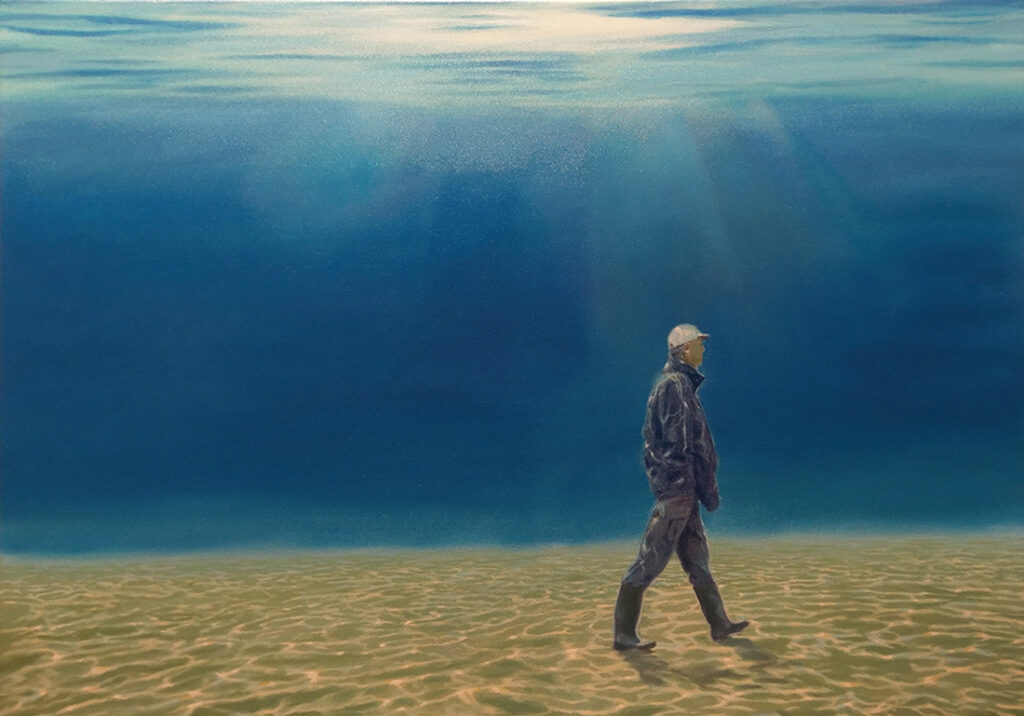
Fine Art Magazine: Your surreal painting of a man walking along the seabed seems to express a related concern about human awareness.
Holger Dempwollf Yes. I wanted to create something unusual, almost absurd. I was thinking about how people move through life without questioning their surroundings. Since humanity’s evolutionary origins lie in the sea, I imagined a man walking casually along the seabed, something obviously impossible. The image is playful, but it also concerns our tendency to overlook the world around us.
Fine Art Magazine: How has your collaboration with Pashmin Art influenced your artistic journey?
Holger Dempwolff: Through Pashmin Art, I have had the opportunity to present my paintings internationally, including at the Rothko Museum, Another Art Museum in Guangzhou, China, and in Museen der Schloss- und Residenzstadt Greiz (Museums in the Castle Town and Royal Capital of Greiz). These opportunities are encouraging, particularly because producing my paintings requires so much time and concentration. International exhibitions bring considerable effort, but they also allow the works to encounter new audiences. That is very motivating, and despite the demanding process, painting continues to give me enormous pleasure.
Exhibitions and Artistic Perspective
Dempwolff has exhibited since 1982, with presentations in Basel, Bern, Langenthal, Frankfurt, London, Barcelona, and beyond. His recent international trajectory includes the Rothko Museum (2025–2026), Another Art Museum in Guangzhou (2026), and the Museen der Schloss- und Residenzstadt Greiz, Thuringia (2026), through Pashmin Art Consortia. Across these diverse cultural contexts, his paintings remain committed to an artistic language in which traditional craftsmanship serves contemporary reflection. Beneath their carefully rendered surfaces, beauty and uncertainty coexist, reminding us that the quietest images can sometimes raise the most unsettling questions.
The interview was conducted by Dr. Davood Khazaie (Literary Art Critic and International Curator).